
Every season tells a story. Spring speaks of fresh beginnings, summer radiates energy, autumn reflects change, and winter symbolizes rest and resilience.
That’s why metaphors for seasons have become one of the most powerful writing tools for students, teachers, poets, authors, bloggers, and anyone who wants to express emotions in a creative way.
Whether you’re writing a poem, crafting a speech, improving an essay, or looking for unique figurative language, finding the right seasonal metaphor can be challenging. Most lists offer only a few common examples without explaining what they mean or when to use them.
This guide is different. You’ll discover 265+ original metaphors for seasons, complete with clear meanings, example sentences, writing tips, and practical uses.
You’ll also learn the symbolism behind each season, how to choose the perfect metaphor for your message, and common mistakes to avoid. By the end, you’ll have everything you need to write with more creativity, emotion, and confidence.
Quick Answer
Metaphors for seasons compare the four seasons—spring, summer, autumn (fall), and winter—to people, emotions, life stages, relationships, success, failure, or personal growth without using the words like or as.
Examples include:
- Spring is life’s first smile.
- Summer is the heart on fire.
- Autumn is nature’s farewell letter.
- Winter is the world’s quiet blanket.
These metaphors help writers express emotions and ideas in a vivid, memorable way.
A season metaphor describes one thing by comparing it directly to a season. Spring often represents new beginnings, summer symbolizes growth and energy, autumn reflects maturity and change, while winter stands for rest, hardship, or reflection. Writers use these metaphors to make descriptions more emotional, colorful, and meaningful.
Key Takeaways
- Seasons symbolize different stages of life.
- Spring often means hope and fresh starts.
- Summer represents energy, joy, and success.
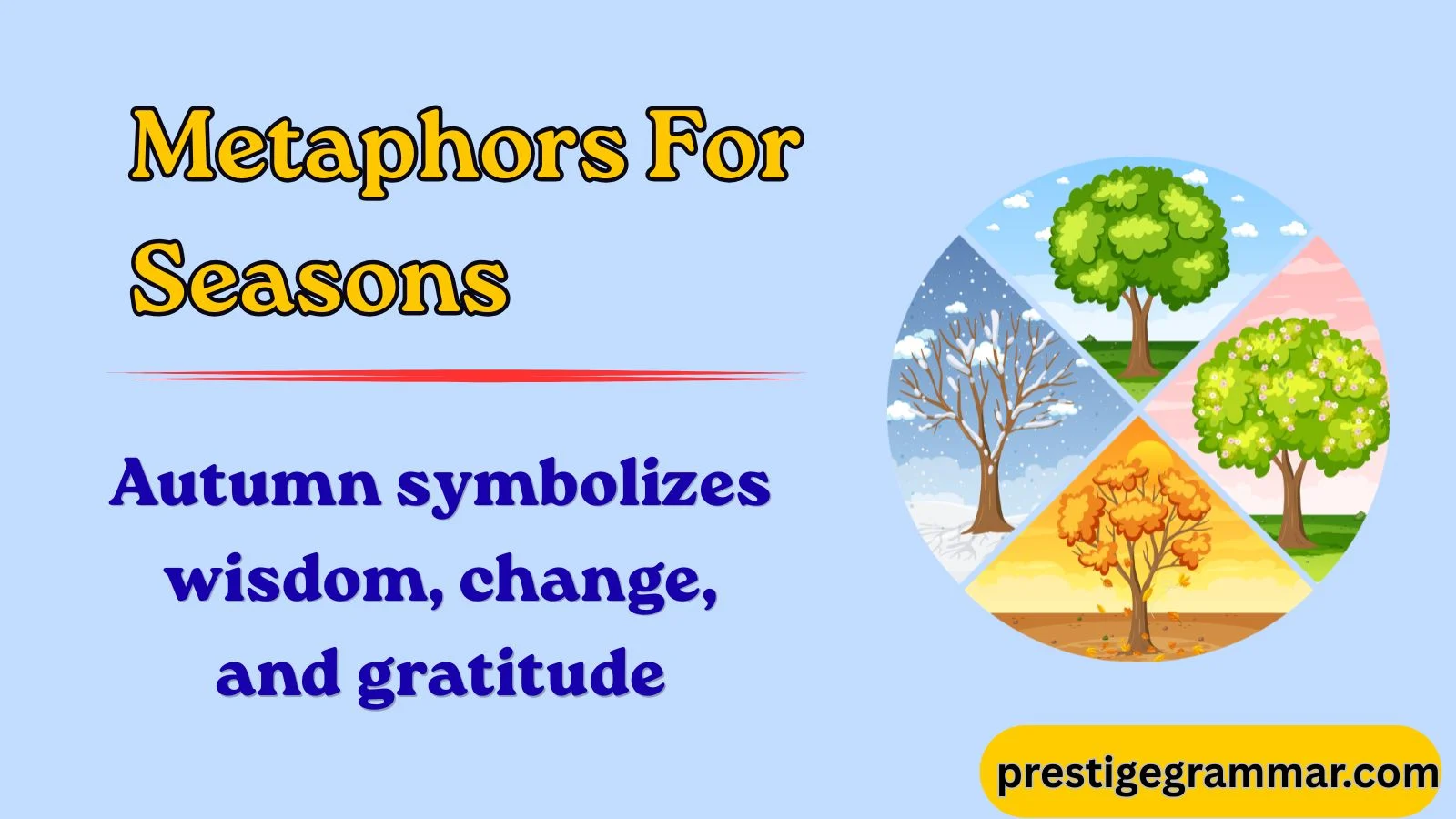
- Autumn symbolizes wisdom, change, and gratitude.
- Winter reflects rest, silence, challenges, or endings.
- Strong metaphors create emotion instead of simply describing facts.
- Original metaphors make your writing more memorable.
Understanding Season Metaphors
What Is a Metaphor?
A metaphor is a figure of speech that says one thing is another to highlight a shared quality.
Instead of saying:
Life is like a journey.
A metaphor says:
Life is a journey.
Season metaphors work the same way. They connect the qualities of each season to people, experiences, or emotions.
For example:
- Childhood is spring.
- Success is summer.
- Middle age is autumn.
- Old age is winter.
These comparisons are not literal. They help readers imagine ideas more clearly.
Why Writers Use Metaphors for Seasons
Season metaphors are popular because almost everyone understands the cycle of the seasons. They create instant mental images and emotional connections.
They help writers:
- Show change naturally.
- Describe emotions vividly.
- Explain life’s stages.
- Add beauty to poetry.
- Strengthen storytelling.
- Make essays more engaging.
- Create memorable speeches.
A single season metaphor can communicate an entire emotional journey in just a few words.
The Symbolism Behind Each Season
| Season | Common Symbolism | Typical Emotions |
|---|---|---|
| Spring | Birth, hope, renewal | Happiness, excitement |
| Summer | Growth, strength, success | Passion, confidence |
| Autumn | Change, wisdom, gratitude | Reflection, peace |
| Winter | Rest, hardship, endings | Loneliness, patience, calm |
Remember, these meanings are flexible. A creative writer can give any season a unique interpretation.
Spring Metaphors
Spring is the season of new life. It represents fresh beginnings, hope, healing, opportunity, and growth.
1. Spring Is Life’s First Smile
Meaning: A joyful beginning after hardship.
Best Use: New opportunities, recovery, fresh starts.
Original Example Sentence:
After months of uncertainty, her new job became life’s first smile of spring.
Tone: Hopeful
Writing Tip: Use this metaphor after describing a difficult period to create emotional contrast.
Alternative Version:
Spring is hope waking up.
2. Spring Is a Blank Canvas
Meaning: Unlimited possibilities.
Best Use: New projects, education, career changes.
Original Example Sentence:
Graduation opened a blank spring canvas waiting for bold dreams.
3. Spring Is the Earth’s Deep Breath
Meaning: Nature coming back to life.
Best Use: Nature writing and descriptive essays.
Original Example Sentence:
Every blossom reminded us that the earth had taken a deep spring breath.
4. Spring Is Hope Wearing Green
Meaning: Optimism becoming visible.
Best Use: Poetry and inspirational writing.
Original Example Sentence:
The tiny leaves proved that hope was wearing green once again.
5. Spring Is Tomorrow’s Promise
Meaning: Better days are ahead.
Best Use: Motivational speeches and personal stories.
Original Example Sentence:
Even after failure, spring remained tomorrow’s promise.
6. Spring Is the World’s Alarm Clock
Meaning: Everything begins again.
Best Use: Describing renewal.
Original Example Sentence:
Singing birds became the world’s spring alarm clock.
7. Spring Is a Painter With Endless Green
Meaning: Nature fills the world with color.
Best Use: Creative descriptions.
Original Example Sentence:
Overnight, spring painted every hill with fresh green strokes.
8. Spring Is a Door Opening
Meaning: New opportunities appear.
Best Use: Personal growth and career writing.
Original Example Sentence:
College became the spring door to endless possibilities.
9. Spring Is a Whisper of Hope
Meaning: Quiet encouragement.
Best Use: Emotional storytelling.
Original Example Sentence:
The first flower was hope whispering through the soil.
10. Spring Is the Heart Learning to Dance Again
Meaning: Emotional healing.
Best Use: Recovery, friendship, love.
Original Example Sentence:
After years of sadness, laughter became the heart’s spring dance.
Summer Metaphors
Summer symbolizes energy, achievement, confidence, warmth, and abundance.
11. Summer Is a Heart on Fire
Meaning: Passion and enthusiasm.
Best Use: Love stories and motivational writing.
Original Example Sentence:
During the championship season, the team became a heart on fire.
Tone: Energetic
Alternative Version:
Summer is passion burning brightly.
12. Summer Is the Crown of the Year
Meaning: The peak or highest point.
Best Use: Success stories.
Original Example Sentence:
Winning the award became the summer crown of her career.
13. Summer Is Golden Laughter
Meaning: Happiness and carefree moments.
Best Use: Childhood memories.
Original Example Sentence:
Every family picnic echoed with golden summer laughter.
14. Summer Is Nature’s Festival
Meaning: Full beauty and celebration.
Best Use: Descriptive writing.
Original Example Sentence:
Blooming gardens transformed the countryside into nature’s summer festival.
15. Summer Is an Open Window
Meaning: Freedom and opportunity.
Best Use: Travel writing.
Original Example Sentence:
Vacation felt like an open summer window inviting adventure.
16. Summer Is a River of Sunshine
Meaning: Endless warmth and joy.
Best Use: Poetry.
Original Example Sentence:
Their laughter flowed like a river of summer sunshine.
17. Summer Is the Engine of Growth
Meaning: Progress and productivity.
Best Use: Business or education.
Original Example Sentence:
Those busy months became the engine of summer growth.
18. Summer Is the Sun’s Symphony
Meaning: Everything feels alive.
Best Use: Nature writing.
Original Example Sentence:
Birds, flowers, and butterflies joined the sun’s summer symphony.
19. Summer Is a Basket Overflowing With Dreams
Meaning: Plenty and achievement.
Best Use: Inspirational writing.
Original Example Sentence:
Years of hard work finally became a basket overflowing with summer dreams.
20. Summer Is the Loudest Song of Life
Meaning: Full energy and excitement.
Best Use: Storytelling.
Original Example Sentence:
Youth often feels like the loudest song of summer.
Using Season Metaphors in Different Types of Writing
Season metaphors are flexible because they fit many kinds of writing. The same metaphor can create different emotions depending on the context.
| Writing Type | How Season Metaphors Help | Example |
|---|---|---|
| Poetry | Build vivid imagery | Spring opened its green hands. |
| Stories | Show character growth | He entered the winter of his life. |
| Essays | Explain abstract ideas | History moves through seasons of change. |
| Speeches | Inspire audiences | Every challenge is followed by spring. |
| Blogs | Make ideas memorable | Creativity blooms in spring. |
| Journals | Express feelings | Today feels like a quiet autumn. |
Tips for Writing Strong Season Metaphors
- Base your metaphor on the natural qualities of each season.
- Keep the comparison clear and meaningful.
- Avoid mixing unrelated metaphors in the same sentence.
- Create fresh images instead of relying on overused phrases.
- Match the season to the emotion or message you want readers to feel.
- Let the metaphor support your writing instead of overwhelming it.
Autumn Fall Metaphors
Autumn is the season of change. Leaves turn bright colors before they fall, crops are harvested, and nature begins to slow down. Because of this, autumn often symbolizes maturity, wisdom, gratitude, reflection, transformation, and letting go.
Unlike spring, which focuses on beginnings, autumn reminds us that change can also be beautiful.
21. Autumn Is Nature’s Farewell Letter
Meaning: A graceful ending before a new beginning.
Best Use: Poetry, emotional stories, personal reflection.
Original Example Sentence:
The golden leaves were nature’s farewell letter to another wonderful year.
Tone: Reflective
Writing Tip: Use this metaphor when describing peaceful endings rather than sadness.
Alternative Version:
Autumn is nature’s goodbye note.
22. Autumn Is a Wise Teacher
Meaning: Experience brings knowledge.
Best Use: Essays, motivational writing.
Original Example Sentence:
Every mistake became an autumn teacher, showing him how to grow.
23. Autumn Is a Golden Treasure Chest
Meaning: A season full of valuable experiences.
Best Use: Nature writing.
Original Example Sentence:
The forest opened its golden treasure chest beneath our feet.
24. Autumn Is Time’s Gentle Artist
Meaning: Change happens slowly and beautifully.
Best Use: Descriptive writing.
Original Example Sentence:
Every colorful tree showed that time had become a gentle artist.
25. Autumn Is the Library of Memories
Meaning: A collection of life’s experiences.
Best Use: Memoirs and reflective essays.
Original Example Sentence:
Looking through old photographs felt like walking through autumn’s library of memories.
26. Autumn Is the Bridge Between Yesterday and Tomorrow
Meaning: A season of transition.
Best Use: Personal growth writing.
Original Example Sentence:
Graduation became an autumn bridge leading toward a new future.
27. Autumn Is a Basket of Gratitude
Meaning: Appreciating life’s blessings.
Best Use: Thanksgiving writing and speeches.
Original Example Sentence:
Their family gathering became a basket filled with autumn gratitude.
28. Autumn Is a Painter With Golden Brushes
Meaning: Nature transforms the world with beauty.
Best Use: Creative descriptions.
Original Example Sentence:
Overnight, autumn painted every hill with golden brushes.
29. Autumn Is the Whisper Before Silence
Meaning: Calm before rest.
Best Use: Emotional storytelling.
Original Example Sentence:
The quiet evening felt like autumn whispering before winter’s silence.
30. Autumn Is the Smile of Wisdom
Meaning: Beauty comes from experience.
Best Use: Inspirational writing.
Original Example Sentence:
Her calm advice became the smile of autumn wisdom.
Winter Metaphors
Winter is often linked to rest, patience, hardship, stillness, reflection, survival, and hope waiting beneath the surface.
Although winter can represent loneliness or endings, it also reminds us that every winter eventually leads to spring.
31. Winter Is the World’s Quiet Blanket
Meaning: Peace and stillness.
Best Use: Nature writing.
Original Example Sentence:
Fresh snow became the world’s quiet blanket.
Tone: Calm
Alternative Version:
Winter wrapped the earth in silence.
32. Winter Is Life’s Pause Button
Meaning: A time to slow down.
Best Use: Self-improvement writing.
Original Example Sentence:
After years of rushing, retirement became life’s winter pause button.
33. Winter Is a Patient Teacher
Meaning: Hard times build character.
Best Use: Motivational writing.
Original Example Sentence:
Every challenge became winter’s patient lesson.
34. Winter Is Hope Sleeping Beneath the Snow
Meaning: Better days are coming.
Best Use: Inspirational stories.
Original Example Sentence:
Even during failure, hope slept beneath the winter snow.
35. Winter Is a Silent Guardian
Meaning: Protection through quiet strength.
Best Use: Poetry.
Original Example Sentence:
The snowy mountains stood like winter’s silent guardians.
36. Winter Is the Night Before Dawn
Meaning: Difficult times before success.
Best Use: Motivational speeches.
Original Example Sentence:
His struggles became the winter before his sunrise.
37. Winter Is a Mirror
Meaning: Time for self-reflection.
Best Use: Journals and essays.
Original Example Sentence:
Solitude became winter’s mirror, showing her true self.
38. Winter Is a Locked Garden
Meaning: Growth is temporarily hidden.
Best Use: Symbolic writing.
Original Example Sentence:
His creativity felt like a locked winter garden, waiting to bloom again.
39. Winter Is the Keeper of Strength
Meaning: Endurance during hard times.
Best Use: Stories of resilience.
Original Example Sentence:
Every obstacle revealed winter’s hidden strength.
40. Winter Is the Last Chapter Before a New Book
Meaning: Endings lead to fresh beginnings.
Best Use: Graduation, retirement, recovery.
Original Example Sentence:
Losing that job became the last winter chapter before a brighter story.
Metaphors for the Four Seasons of Life
Writers often compare the stages of life to the changing seasons.
| Life Stage | Season | Symbolic Meaning |
|---|---|---|
| Childhood | Spring | Curiosity, innocence, growth |
| Teenage Years | Early Summer | Energy, learning, discovery |
| Adulthood | Summer | Strength, responsibility, achievement |
| Middle Age | Autumn | Wisdom, gratitude, maturity |
| Old Age | Winter | Reflection, peace, legacy |
Example
Childhood was her spring, adulthood became her summer, middle age turned into autumn, and old age arrived as a peaceful winter.
Metaphors for Love and Relationships
Season metaphors beautifully describe changing relationships.
| Metaphor | Meaning |
|---|---|
| Love is spring. | A fresh romance begins. |
| Love is summer sunshine. | Warm, joyful affection. |
| Love entered autumn. | A mature relationship. |
| Love survived winter. | A relationship endured hardship. |
| Friendship is spring rain. | It helps people grow. |
| Trust is an evergreen tree. | Strong through every season. |
Metaphors for Personal Growth
Personal growth rarely happens overnight. The changing seasons mirror that journey.
| Metaphor | Meaning |
|---|---|
| Failure is winter. | Difficult times teach valuable lessons. |
| Learning is spring rain. | Knowledge helps people grow. |
| Confidence is summer sunlight. | Self-belief shines brightly. |
| Wisdom is autumn fruit. | Experience brings rewards. |
| Dreams are spring seeds. | Small ideas grow into big achievements. |
| Patience is winter snow. | Quiet waiting prepares future success. |
Comparison Table: What Each Season Represents
| Season | Positive Meanings | Possible Negative Meanings |
|---|---|---|
| Spring | Hope, renewal, youth, opportunity | Inexperience |
| Summer | Success, joy, strength, confidence | Pride, excess |
| Autumn | Wisdom, gratitude, maturity | Letting go, change |
| Winter | Rest, peace, resilience, reflection | Isolation, hardship |
How to Create Your Own Season Metaphors
Original metaphors are often more memorable than familiar ones. Follow these simple steps.
Step 1: Choose the Emotion
Ask yourself what feeling you want to express.
Examples:
- Joy
- Fear
- Hope
- Loneliness
- Confidence
- Change
Step 2: Match It to a Season
Think about the qualities of each season.
- Spring = Beginning
- Summer = Energy
- Autumn = Change
- Winter = Reflection
Step 3: Look for Shared Qualities
For example:
Hope grows.
Plants also grow.
You can write:
Hope is spring climbing the hills.
Step 4: Make the Image Specific
Instead of writing:
Life is spring.
Try:
Life is a spring garden waiting for careful hands.
Specific images help readers picture your meaning.
Common Mistakes to Avoid
1. Using Too Many Metaphors Together
Poor:
Life is spring, a river, a mountain, and a candle.
Better:
Life is a spring garden waiting to bloom.
2. Choosing the Wrong Season
If you’re writing about excitement, winter may not fit unless you’re creating contrast.
Always match the season to your message.
3. Copying Overused Expressions
Instead of writing:
Spring is new life.
Try something fresh:
Spring is the world’s first deep breath after a long sleep.
4. Explaining the Metaphor Too Much
Trust readers to understand your imagery.
Instead of writing three sentences explaining a metaphor, let the image do the work.
Expert Tips for Better Season Metaphors
- Observe nature before writing.
- Use sensory details like color, sound, smell, and texture.
- Keep metaphors consistent throughout a paragraph.
- Mix emotion with imagery.
- Create original comparisons instead of repeating famous quotes.
- Read your metaphor aloud to check its rhythm.
- Ask whether the metaphor creates a clear mental picture.
Real-World Uses of Season Metaphors
Season metaphors appear in many forms of writing:
- Poems
- Short stories
- Novels
- Children’s books
- Graduation speeches
- Wedding speeches
- Motivational articles
- Journals
- Blogs
- Song lyrics
- Classroom lessons
- Social media captions
They help readers connect emotionally with ideas that might otherwise feel abstract.
25 More Original Metaphors for Seasons
The following metaphors give you even more creative ways to describe the changing seasons. Use them in essays, poems, stories, speeches, blogs, or journal entries.
| # | Metaphor | Meaning | Best Use | Original Example Sentence |
|---|---|---|---|---|
| 41 | Seasons are life’s heartbeat. | Life moves in natural cycles. | Inspirational writing | Every success and setback proved that the seasons were life’s heartbeat. |
| 42 | Spring is a key to tomorrow. | New opportunities begin. | Motivation | Her first job became the spring key to her future. |
| 43 | Spring is the earth’s smile. | Nature comes alive. | Nature writing | Wildflowers covered the fields as the earth smiled through spring. |
| 44 | Summer is a blazing torch. | Energy and ambition. | Speeches | His determination burned like a summer torch. |
| 45 | Summer is a full harvest basket. | Success after hard work. | Essays | Graduation felt like a basket overflowing with summer rewards. |
| 46 | Summer is the orchestra of light. | Life feels vibrant and joyful. | Poetry | Butterflies danced in summer’s orchestra of light. |
| 47 | Autumn is a quilt of memories. | Past experiences bring comfort. | Memoirs | Family traditions became autumn’s warm quilt of memories. |
| 48 | Autumn is the golden handshake of time. | Accepting change gracefully. | Reflection | Retirement became autumn’s golden handshake. |
| 49 | Autumn is a slow dance with change. | Transformation happens gently. | Personal growth | She accepted change as an autumn dance. |
| 50 | Winter is a hidden workshop. | Growth continues quietly. | Self-improvement | His ideas developed inside winter’s hidden workshop. |
| 51 | Winter is the keeper of quiet courage. | Strength during difficult times. | Motivation | Recovery showed winter’s quiet courage. |
| 52 | Winter is a sleeping orchestra. | Beauty waiting to return. | Creative writing | Bare trees looked like a sleeping orchestra. |
| 53 | Spring is a promise kept. | Hope becomes reality. | Stories | The blooming garden was spring’s promise kept. |
| 54 | Summer is the laughter of the sky. | Bright, cheerful days. | Poetry | Sunshine became the sky’s laughter. |
| 55 | Autumn is wisdom wearing gold. | Experience becomes beautiful. | Essays | Her advice was wisdom dressed in autumn gold. |
| 56 | Winter is the courage to wait. | Patience during hardship. | Inspiration | Healing required winter’s courage to wait. |
| 57 | Spring is a song without fear. | Fresh confidence. | Motivation | Her new beginning sounded like a fearless spring song. |
| 58 | Summer is a river of possibilities. | Endless opportunities. | Personal development | College became a summer river of possibilities. |
| 59 | Autumn is the art of letting go. | Releasing the past. | Self-help | Forgiveness became autumn’s greatest lesson. |
| 60 | Winter is the silence that heals. | Rest restores strength. | Wellness | Solitude became winter’s healing silence. |
| 61 | Seasons are chapters in nature’s book. | Every phase has purpose. | Education | Every month turned another page in nature’s book. |
| 62 | Spring is the first heartbeat of the year. | A joyful beginning. | Descriptive writing | The first blossoms marked the year’s first heartbeat. |
| 63 | Summer is a crown of sunshine. | Peak happiness. | Stories | Their vacation became a crown of sunshine. |
| 64 | Autumn is the sunset of the year. | A beautiful closing chapter. | Poetry | October arrived as the year’s glowing sunset. |
| 65 | Winter is tomorrow waiting quietly. | New beginnings are coming. | Inspiration | Even the coldest days were tomorrow waiting quietly. |
How to Choose the Right Season Metaphor
Not every metaphor fits every situation. Choosing the right one makes your writing stronger.
| If You Want to Express… | Best Season |
|---|---|
| A fresh start | Spring |
| Hope | Spring |
| Youth | Spring |
| Energy | Summer |
| Love and joy | Summer |
| Success | Summer |
| Wisdom | Autumn |
| Gratitude | Autumn |
| Personal change | Autumn |
| Reflection | Winter |
| Patience | Winter |
| Recovery after hardship | Winter leading to Spring |
A simple way to remember this is:
- Spring begins.
- Summer grows.
- Autumn changes.
- Winter rests.
FAQs:
What are metaphors for seasons?
Metaphors for seasons are creative comparisons that use spring, summer, autumn, or winter to represent ideas such as life stages, emotions, relationships, success, or personal growth. They help writers express abstract ideas with vivid imagery.
Example
Spring is the doorway to hope.
Why do writers use season metaphors?
Writers use season metaphors because readers naturally understand the cycle of the seasons. These familiar images make stories, poems, and essays more emotional, memorable, and engaging.
Which season symbolizes new beginnings?
Spring most commonly symbolizes new beginnings, fresh opportunities, growth, hope, and renewal.
Example:
Every sunrise was another spring in her life.
What does winter symbolize in literature?
Winter often represents:
- Rest
- Reflection
- Loneliness
- Patience
- Hardship
- Survival
- Quiet strength
However, it can also symbolize hope because winter is usually followed by spring.
Can seasons represent the stages of life?
Yes. Many writers compare life to the four seasons.
- Spring: Childhood
- Summer: Youth and adulthood
- Autumn: Maturity
- Winter: Old age and reflection
This symbolic pattern appears in literature, speeches, poetry, and storytelling.
What’s the difference between a metaphor and a simile?
A metaphor says one thing is another.
Life is winter.
A simile compares using like or as.
Life is like winter.
Both create imagery, but metaphors are usually stronger and more direct.
How can I create my own season metaphors?
Start by asking three simple questions:
- What idea or emotion do I want to express?
- Which season naturally matches that feeling?
- What image can make that comparison vivid and memorable?
For example, instead of saying:
She felt hopeful.
You could write:
Spring built a garden inside her heart.
This creates a stronger emotional picture.
Conclusion:
The changing seasons have inspired writers for centuries because they reflect the natural rhythms of life. Spring reminds us that every ending can lead to a new beginning. Summer celebrates growth, joy, and achievement.
Autumn teaches us to embrace change with gratitude, while winter encourages patience, reflection, and resilience.
By understanding the symbolism behind each season, you can write with greater depth and creativity. Whether you’re crafting poetry, telling a story, giving a speech, or simply looking for a fresh way to express an idea, season metaphors help transform ordinary language into memorable imagery.
Use the examples in this guide as inspiration, then experiment with your own original comparisons. The most powerful metaphors often come from careful observation and personal experience.
Like the seasons themselves, your writing will continue to grow, change, and flourish over time.

I’m Sarah Collins, a passionate English language writer and content editor dedicated to making grammar simple, practical, and easy to understand. I enjoy creating clear, accurate, and engaging content that helps students, professionals, and everyday learners improve their English with confidence.
My work focuses on English grammar, vocabulary, spelling, punctuation, writing tips, word meanings, and common language mistakes. Every article is carefully researched, fact-checked, and written in a reader-friendly style to ensure accuracy and real value.
Whether you’re looking to strengthen your grammar skills, expand your vocabulary, or become a more confident writer, my goal is to provide practical guidance that makes learning English enjoyable and effective.